We understand that the extension of Manxman's dry dock programme may affect customers' travel plans. To help keep everyone informed, this page below provides the latest updates in one place.
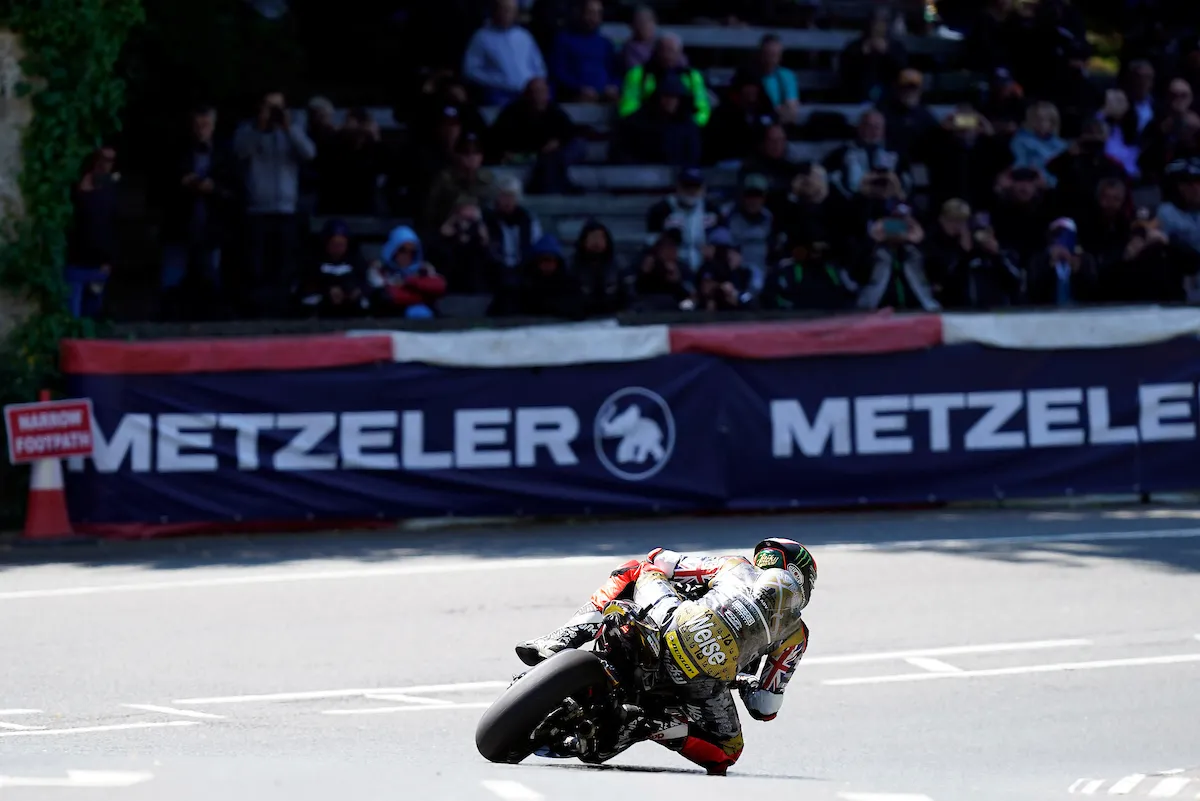
Few sporting events can claim a heritage as rich, raw and revered as the Isle of Man TT. For more than a century, the TT (Tourist Trophy) has been a proving ground for the world’s greatest riders and machines — a place where speed is measured not on a racetrack, but on public roads bordered by stone walls, telegraph poles, kerbs and cottages.
Why was the TT created?
The Isle of Man TT was created to prove that motorcycles could perform under real road conditions, but in the early 1900s, mainland Britain had strict laws limiting motor racing on public roads. Organisers needed a place where motorcycles could be tested and raced legally at speed. The Isle of Man, with its self-governing powers and winding network of public roads, became the perfect setting.
The first Tourist Trophy motorcycle races were held on the island in 1907, but they weren’t run on the now-famous Snaefell Mountain Course. Instead, riders competed on the St John’s Short Course, a far slower and more contained loop.
By 1911, the event had outgrown those early routes. That year, organisers introduced the 37¾-mile Mountain Course, which is largely the same as the iconic circuit used today. It was designed not as a stadium-style race, but as a real-world test: steep climbs, fast straights, blind corners, rough surfaces, and unpredictable weather.
Growth in popularity
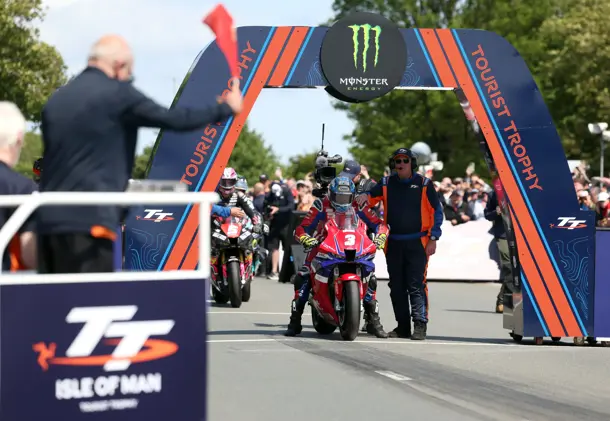
While circuit racing elsewhere began to move towards enclosed tracks, the Isle of Man embraced the challenge. Instead, they raced against time, starting at 10-second intervals behind each other in pursuit of the fastest lap without battling shoulder-to-shoulder in packs.
The unique format created a particular kind of drama. The Mountain Course demanded memory and precision, as riders had to know every bump, camber and braking point. Success wasn’t just about speed – it was about mastering the island itself.
As motorcycle technology advanced through the 1920s and 1930s, the TT became the defining test of performance and endurance. Manufacturers wanted to win here because it proved credibility. Riders wanted to win because it proved greatness.
Crowds grew year after year. Visitors arrived not only for the racing, but for the atmosphere that came from this spectacle being not built for television but real, raw motorsport.
Entering the modern era and gaining international recognition
By the mid-20th century, the TT had become a centrepiece of global motorcycle racing. From 1949 to 1976, the Isle of Man TT was part of the FIM Grand Prix World Championship. The biggest names in the sport came to race the Mountain Course, and the world’s best manufacturers used the TT to prove their engineering.
But the very thing that made the TT legendary – its uncompromising roads – also made it increasingly controversial. As racing bikes became faster, the risks grew. Instead of wide run-offs or gravel traps, the course had walls, kerbs and sheer drops.
During the 1970s, safety concerns reached a tipping point, and the TT was removed from the World Championship calendar, as the sport shifted toward purpose-built circuits.
Instead of fading, the Isle of Man TT became even more iconic – it was no longer just a round of a championship, but a race that stood apart from the others. For many, it became the ultimate test: a specialist discipline that demanded a different kind of rider.
By the 1990s and 2000s, the TT had evolved into a world-famous motorsport phenomenon. Media coverage expanded, onboard cameras brought fans closer than ever, and the race became a bucket-list event for riders and spectators worldwide.
Today, winning a TT is considered by many riders to be as meaningful as a world title.
Lap records over the decades
If there is one statistic that tells the story of the TT’s evolution, it’s lap speed.
In 1911, the first TT winner, Oliver Godfrey, completed the Mountain Course at an average speed of around 47mph. That number seems almost gentle today, but at the time, on narrow public roads with early tyres and basic brakes and suspension, it was extraordinary.
Over the decades, progress came in waves:
1920s–1930s: engine reliability improved, and lap speeds pushed steadily upwards, with Tommy de la Hay setting a new record in 1920 with 55.6mph, with the 1939 record sitting leagues ahead at 89.3mph, courtesy of Georg Meier.
1950s–1960s: the golden era of Grand Prix racing saw factory teams arrive with cutting-edge machines. Speeds surged from 92.3mph per lap with Geoff Duke in 1950, up to Malcolm Uphill’s 99.9mph in 1969.
1970s–1980s: the bikes became even more powerful, but the course remained unchanged, making skill more important than ever. By the end of the 80s, Steve Hislop had set the new record at 119.3mph.
1990s–2000s: superbike technology transformed the TT. Aerodynamics, tyre grip and suspension brought unprecedented stability, helping John McGuinness achieve a lap average of 127.9mph.
2010s–present: lap speeds entered a new dimension, with the current record sitting at 136.358mph, achieved by Peter Hickman in 2023 on a BMW M10000RR.
That speed means an entire 37¾-mile lap, filled with villages, hairpins, mountain bends, and high-speed straights, completed at an average speed faster than many race circuits.
Why riders risk everything at the TT
To outsiders, the Isle of Man TT can seem impossible to understand. Why would anyone race at these speeds on public roads? The answer is complex and deeply rooted in motorsport culture.
For many riders, the TT is the ultimate expression of motorcycle racing. It strips away the controlled environment of modern circuits and replaces it with something raw: pure riding skill, total concentration, and a bonding with the road. Riders speak of the TT as a mental discipline as much as a physical one. A single lap contains more corners than most circuits see in an entire race weekend. Every braking marker, gear change and throttle input must be memorised.
But there is something else too: legacy.
To win at the TT is to join a list of names etched into motorcycling history. It’s to be remembered not just as a fast rider, but as someone who conquered the Mountain Course.
And for the fans, the TT represents a form of motorsport that is vanishing from the world: a place where tradition, bravery and skill still matter as much as technology.
It is, undeniably, dangerous. The TT has always carried risk, and every rider who lines up understands that. But for those who race it, the reward is something few other sports can offer: the chance to achieve immortality on the most legendary road circuit.
Legendary TT moments
The Isle of Man TT is built on moments, stories passed down from generation to generation of fans. Some are records. Some are rivalries. Some are feats of survival and determination.
One of the most iconic eras was the rise of Mike “The Bike” Hailwood, whose talent and charisma made him a global superstar. His TT victories in the 1960s became part of racing folklore, but it was his dramatic return in 1978 (after more than a decade away from the TT) that became the stuff of legend. Against modern competition, Hailwood came back and won, proving his mastery of the Mountain Course.
Then there’s Joey Dunlop, perhaps the most beloved figure in TT history. His career wasn’t only defined by wins, but by the relationship he built with the island and its people. Dunlop became synonymous with the TT itself, a rider who embodied humility, courage and relentless consistency. His legacy remains one of the deepest emotional threads in TT culture.
Then, in the modern era, the battles between John McGuinness, Michael Dunlop, Ian Hutchinson, Peter Hickman, and others have pushed the TT into new territory. Hutchinson’s 2010 achievement of five TT wins in a single week remains one of the most astonishing feats in modern road racing.
And then came the Hickman era, a new benchmark of speed, highlighted by his 2018 lap record, achieved with a level of precision that stunned even seasoned TT followers.
These moments aren’t just sporting highlights; they are chapters in an ongoing story that continues every summer on the island.
Experience the Isle of Man TT with Steam Packet
To watch the Isle of Man TT in person is to experience motorsport in its purest form. You don’t sit in a grandstand far from the action. You stand by the roadside where the same walls and bends have challenged riders since 1911. You feel the air move as they pass. And you realise instantly why the TT has become a global legend.
The TT is more than racing; it’s an island-wide festival. The Isle of Man transforms into a celebration of speed and heritage, with fans from around the world gathering in towns, campsites, pubs and viewing points across the Mountain Course.
It’s also one of the few sporting events where you can explore the very course you’ve just watched, by riding or driving the same roads after the closures lift and seeing first-hand just how narrow, fast and technical the route truly is.
Whether you’re coming for the first time or returning as a lifelong fan, travelling with the Isle of Man Steam Packet Company is part of the TT tradition. For generations, we’ve carried riders, race teams and fans across the Irish Sea.